Somewhere between the tenth prototype and the ten-thousandth unit, every product hits an awkward gap. Too many parts to keep printing one at a time, too few to justify a mold. Injection molding shops call it “low volume” and quote it reluctantly. For a print farm it is the sweet spot. This guide explains when 3D printing wins that band, when it does not, and how to design and order so it works.
Below a few thousand units, printing usually beats molding on total cost because there is no tooling to pay off. Toward 5,000 and beyond, it still wins when you need design changes, multiple SKUs, or parts sooner than a mold can be cut. Past that, mold.
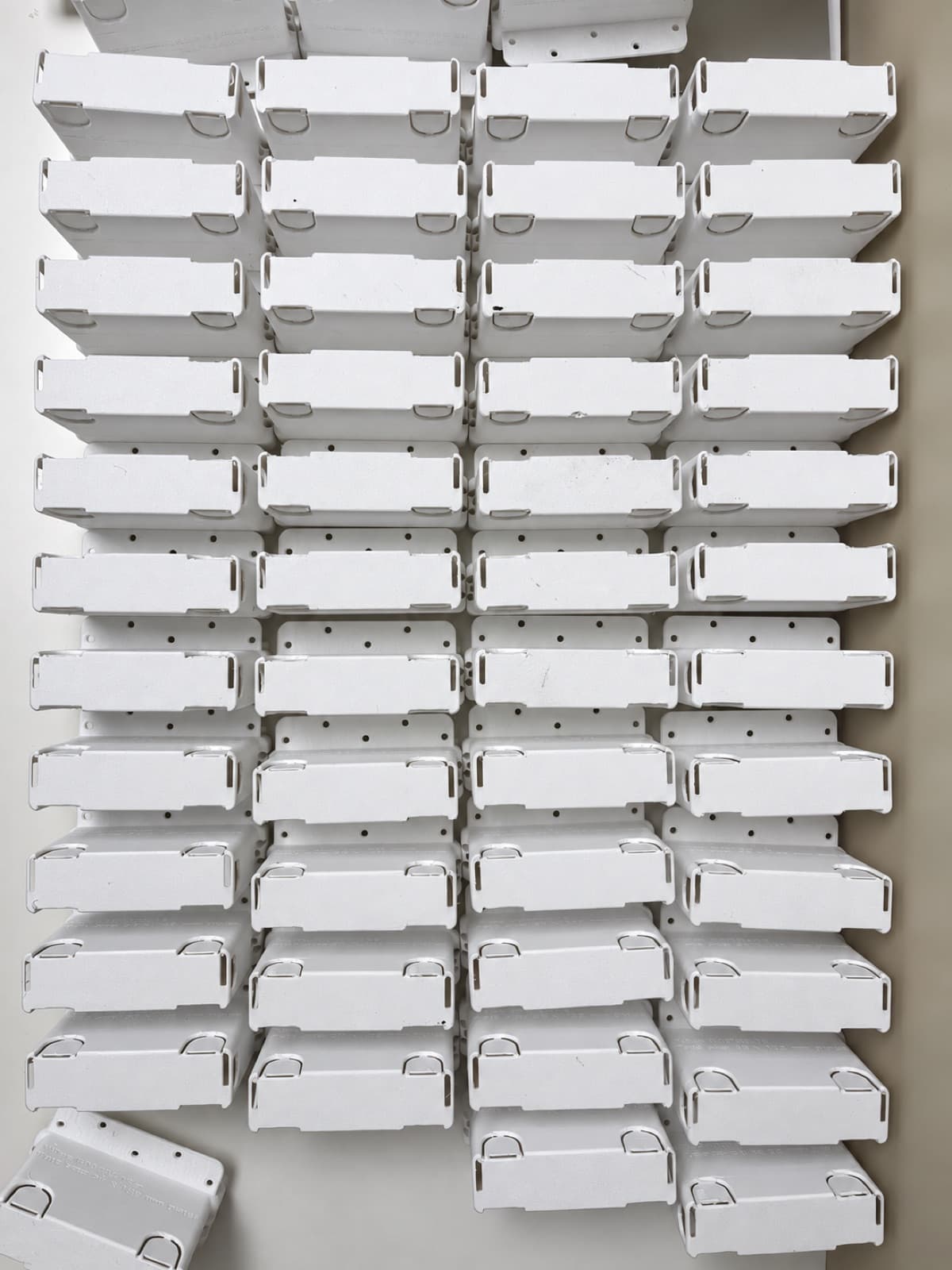
The math that decides it: tooling amortization
Injection molding has a near-zero marginal cost per part and a large fixed cost up front: the mold. A simple single-cavity aluminum tool runs into the thousands of dollars; a production steel tool with side actions runs into the tens of thousands. That cost gets divided across every part you ever make, so the unit price only looks good at scale.
3D printing is the opposite shape. There is no tooling, so the price of part number one is essentially the price of part number five hundred, minus the quantity discounts that our quote tool applies automatically. That is also why we can publish the rate: it is a published $/cm³ material rate plus machine time and a $5 setup fee per order, and the cost breakdown article walks through three example quotes taken straight from the pricing engine.
| Quantity | Injection molding | FDM 3D printing | Usually wins |
|---|---|---|---|
| 1–50 | Tooling dominates; often not quoted | Same unit price as prototypes | Printing |
| 50–500 | Tooling still most of the cost | Quantity discounts kick in | Printing |
| 500–5,000 | Unit cost falling fast | Flat unit cost, no changeover | Depends on design churn and timing |
| 5,000+ | Cents per part | Flat | Molding |
Four situations where printing wins even at higher volume
1. The design is still moving
A mold locks the design. Every revision is a tooling change, a delay and an invoice. A printed part changes when the file changes. If you ship a product that gets field feedback, printing lets you fold revision three into next week’s batch. This is the whole premise of our rapid prototyping service, and it does not stop being true at 300 units.
2. You have many SKUs and small runs of each
Twelve variants of an enclosure, forty of each, is a nightmare for molding (twelve tools or a complex family mold) and trivial for printing. Consumer electronics and tabletop gaming accessories live here. So does anything sold in sizes.
3. You need parts before a mold could exist
Cutting a tool takes weeks. If the launch is in three, the first production batch is printed whether or not the long-term plan is molding. Bridge production is one of the most common jobs on our farm.
4. Geometry that a mold cannot release
Internal channels, undercuts, lattice infill, consolidated assemblies. Molding needs draft angles and pullable cores. Printing does not care, which often lets you replace three molded parts and their fasteners with one printed part.
Where molding still wins
- Cosmetic Class-A surfaces. FDM parts have visible layer lines. Post- processing helps; it does not make them injection-molded.
- Very thin walls at scale. Below about 1 mm, FDM gets slow and fragile.
- Tens of thousands of identical parts. At that point the mold has paid for itself many times over.
- Materials FDM cannot print. Glass-filled PP, silicones, optical clarity. Our FDM vs SLA guide covers the resin side of that question.
- Absolute part strength in the same material. A printed part is a stack of bonded layers, not continuous material. Measured against injection-moulded ABS, FDM parts reached 65–72% of tensile strength and 80–90% of compressive strength, varying with raster orientation (Ahn et al., 2002). For most brackets and housings that is plenty — and you can buy the margin back by moving up a material — but if your part is already at the edge of its envelope when moulded, printing it will not get you there.
Materials for production parts, not prototypes
The mistake we see most is prototyping in PLA and then ordering 400 production parts in PLA. It prints beautifully and softens in a hot car. For parts that have to survive service, the materials guide is the reference; the short list:
- PETG for general enclosures, brackets and anything that meets chemicals or moisture.
- ABS where you need heat stability and post-machining.
- ASA outdoors; it is ABS that does not chalk in the sun.
- Polycarbonate for impact and 113 °C heat deflection.
- TPU for grips, gaskets, feet and bumpers.
- PET-CF, PA6-CF and PPS-CF when stiffness, heat or chemical exposure rule out everything above. Our carbon fiber 3D printing service covers how those are run.
Read PLA vs PETG vs ABS vs PET-CF for the decision framework behind that list.
Designing a part for a print run instead of a print
A one-off can be printed in any orientation with any amount of support. A run of 500 cannot, because every minute of support removal is multiplied by 500. Small changes pay off enormously:
- Give the part a flat face to print on. No supports, better dimensional accuracy, faster QC.
- Chamfer instead of fillet on the bottom edge. Fillets on the bed create elephant’s foot; a 45° chamfer prints clean.
- Keep walls at multiples of the nozzle width (0.4 mm nozzle: 0.8, 1.2, 1.6, 2.0 mm). Odd wall thicknesses waste time on gap fill.
- Use heat-set inserts for anything threaded. The insert design guide has the boss dimensions.
- Nest small parts. Tell us the parts ship together and we can plate them together, which is where a lot of the quantity discount actually comes from.
If you would rather have us check the design before committing the run, the design-for-printing consultation exists for exactly that, and the STL preparation guide covers the export side.
How a production order actually runs at TAKT 3D
Upload the file to the instant quote tool, set the quantity, and the unit price adjusts on the spot. The lead time shown is computed from quantity and part size, so a run of 300 shows a realistic date rather than the single-part default. You can pay by card at checkout; established business accounts can also pay by ACH or purchase order. The low-volume production page has the full detail, including how repeat orders work.
Parts ship UPS Ground from $15 or can be picked up in San Diego by arrangement. Our industries pages show where production runs in PETG, ASA and carbon fiber end up — aerospace, medical, robotics and automotive work.
Frequently asked questions
What counts as low-volume manufacturing?
Roughly 10 to 5,000 units per run. Below that it is prototyping; above it, injection molding or casting usually wins on unit cost. 3D printing covers the whole low-volume band with no tooling.
Is 3D printing cheaper than injection molding for small runs?
Almost always below a few thousand parts, because there is no mold to amortize. Molds cost thousands to tens of thousands of dollars; a printed part costs the same on unit 1 and unit 500, minus quantity discounts.
How many parts can a 3D printing service make per week?
It depends on part size and material. A print farm running dozens of machines can turn out hundreds of palm-sized parts a day. TAKT 3D quotes production lead time at checkout based on quantity and part size.
Which materials work for low-volume production parts?
PETG and ABS for general enclosures and fixtures, ASA outdoors, PC for impact, TPU for flexible parts, and carbon-fiber composites (PET-CF, PA6-CF, PPS-CF) where stiffness or heat matter.
Bottom line
Low-volume manufacturing is not a compromise version of molding. It is a different tool with a different cost curve: flat, tooling-free, and indifferent to design changes. If your quantity is in the hundreds, your design is still evolving, or you need parts before a mold could be cut, upload the file and see the number.
Sources
Claims on this page that are not about our own shop, pricing, or turnaround are attributed inline. Full references:
- Ahn, S.-H., Montero, M., Odell, D., Roundy, S. & Wright, P. K. "Anisotropic material properties of fused deposition modeling ABS." Rapid Prototyping Journal 8(4), 248–257 (2002). doi.org/10.1108/13552540210441166 — free full text (Peer-reviewed research)