The customer makes light switches the way a watchmaker makes watches: hand-finished plates in brass, bronze and nickel, specified by architects for residences where the switch is part of the interior. Their North American office is here in San Diego, and its projects are ordered from it, residence by residence.
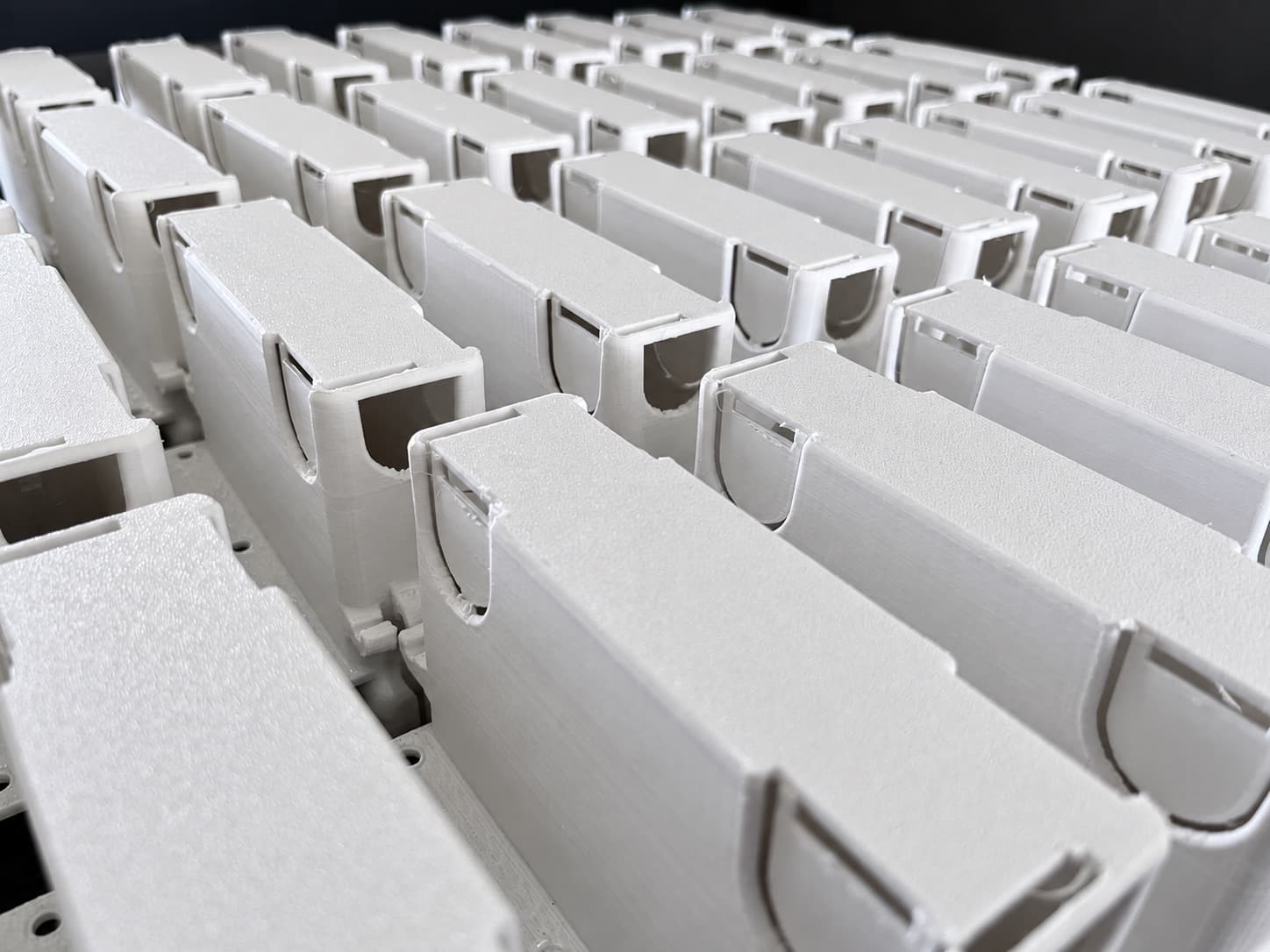
Behind every one of those plates sits a part nobody is meant to see. A plain box, recessed into the wall, that the plate mounts onto. It has to match the plate’s footprint exactly, hold the keypad hardware, and take a cable. There is one for every plate size in the range, and the range is wide. That box is what we make.
How the program runs
A size family, not a part
The first request was not “print this” but “print these”: the same box across the plate sizes their projects were using, plus a double-mount variant, plus small clips in bulk. Each size is its own STEP file from their engineering team. We treat the family as one product with a dozen SKUs, because that is how they order it.
White PETG, and why
A box that lives inside a wall gets handled hard on the way in and is never seen again. PETG is tough, holds its dimensions, and comes off the printer in a clean white that an installer can find in a dark cavity. It runs reliably in quantity, which matters when a run has to land on a date.
A price sheet instead of a quote
Quoting a dozen sizes every month would have been the slowest part of the job. So there is a sheet: one base price per plate size, and quantity tiers that key off the whole order rather than each line, so a mixed order of several sizes earns the break together. It lives in a private catalog in our client portal with the files attached, and a reorder is a quantity and a date.
Adapting to American walls
A European plate does not always land on a European box. When a project needed a keypad to mount onto a standard US four-inch outlet box, the CAD side of the shop drew a ring adapter to bridge the two, and it joined the catalog like any other size. When a plate size changes, the box changes with it, billed as an hour or two of design rather than a new tool.
By the residence, on a date
Orders arrive tied to a specific home — a residence number, a project name — with the sizes that house needs. A handful of boxes for a late change can turn around in days; a full run for a large project takes about three weeks. They collect from our Miramar shop, and the next project follows.
Nearly two years in
The program started under our former name in early 2025 and has not stopped. It has survived a rebrand on our side, new plate sizes on theirs, and a move from emailed invoices to the portal. Nothing in it has needed a mold, because no single size would ever justify one.
Why we like this one
It is the least dramatic case study we will ever publish, and that is the point. No failed samples, no heroics: a manufacturer with a real product needed a plain part in many sizes, on demand, and printing turned out to be the right way to make it. The work is in the system around the part — the files, the sheet, the catalog, the pickup habit — so that the twentieth reorder is as boring as the second.
If you have a family of parts like it, a few dozen at a time, in many variants, no tooling, that is the kind of production we are built for.
The first year of this work was delivered under our former name, 037 Designs. Same shop, same machines — we now operate as TAKT 3D, and the program continues.
Frequently asked questions
Can you keep our parts on file and reorder without a new quote?
Yes. Repeat parts get a private catalog in our client portal with each item’s file, material and quantity tiers already set, so a reorder is a quantity and a date, not a fresh quote. Prices move only when we publish a change.
Are 3D printed back boxes code-rated or listed?
We print to the customer’s drawing and material spec and hold the dimensions; any electrical listing or code question belongs to the customer’s own engineering. On this program the boxes are mounting and trim parts specified by the manufacturer, and we make no listing claim about them.
When does printing beat a mold for a production part?
When the part is needed a few dozen at a time, in many sizes, for years. A mold is paid for up front and only pays back at volume in one geometry. A dozen box sizes consumed by the residence never reach that volume in any one of them, so printing stays cheaper in total and every size can change tomorrow.