
Taylor Guitars builds some of the best-known acoustic guitars in the world, about twenty minutes up the road from our shop. In July 2024 one of their product development engineers called us about a small black plastic bezel.
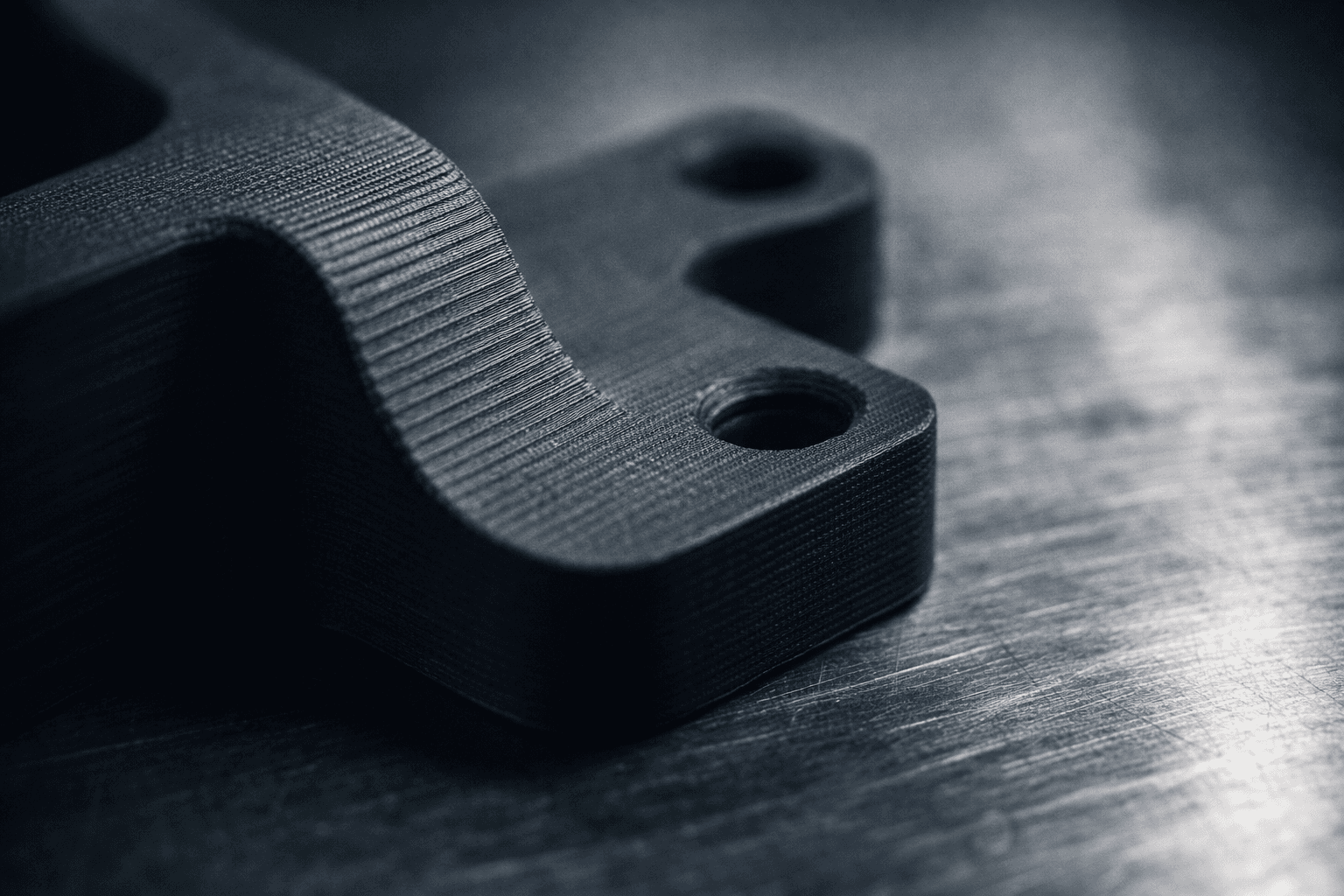
It is an adapter part — it lets a guitar body built around one pickup system take Taylor’s own Expression System electronics instead. Their repair department needs it whenever one of those instruments comes in for service. The part had always been injection molded, with a fine micro-texture across the face you can see. Nothing was wrong with it. There was just no sensible reason to cut a whole new mold to keep a repair bench stocked.
Which sounds like an easy print job. It was not, and the reason why is the interesting part.
How it actually went
The call, and samples the same day
They sent a drawing, a STEP file and an STL. We had parts in their hands that afternoon — two versions, one with our standard surface texture and one with a texture we’d tuned specifically to imitate the look of the mold.
“Mechanically fine. Cosmetically, no.”
This was the verdict that shaped the whole project. One of Taylor’s master repair technicians had no complaint about how the parts held up — the mechanics were never in question. The finish was wrong. On a structural bracket nobody looks twice at layer lines. This bezel sits on the visible face of an instrument somebody saved up for, and Taylor was not going to put a part on a customer’s guitar that looked printed.
PLA meets a heat gun and loses
We’d sent PLA samples too, because PLA is cheap and comes off the printer looking good. Those died fast: the repair process includes a step that heats and flattens the part, and PLA deflects at about 52 °C. Straight back to ABS — the same family as the original molded part, heat-stable, and receptive to smoothing. The lesson we keep relearning: the material is chosen by the process around the part, not by the part.
A photograph with red circles on it
The best spec we got on this whole job. Rather than describe what was off, Taylor marked up a photo and circled the exact areas that still weren’t right. We changed print settings and had new samples ready the next day. Better — and still not good enough for guitars sitting in the repair queue.
Higher resolution, and a yes
One more round, printed finer. Those were the ones that passed. Seven and a half weeks after the first phone call, the part was approved for production — signed off by the same people who had turned down the first attempt, which is the only kind of approval worth having.
Then it simply stayed
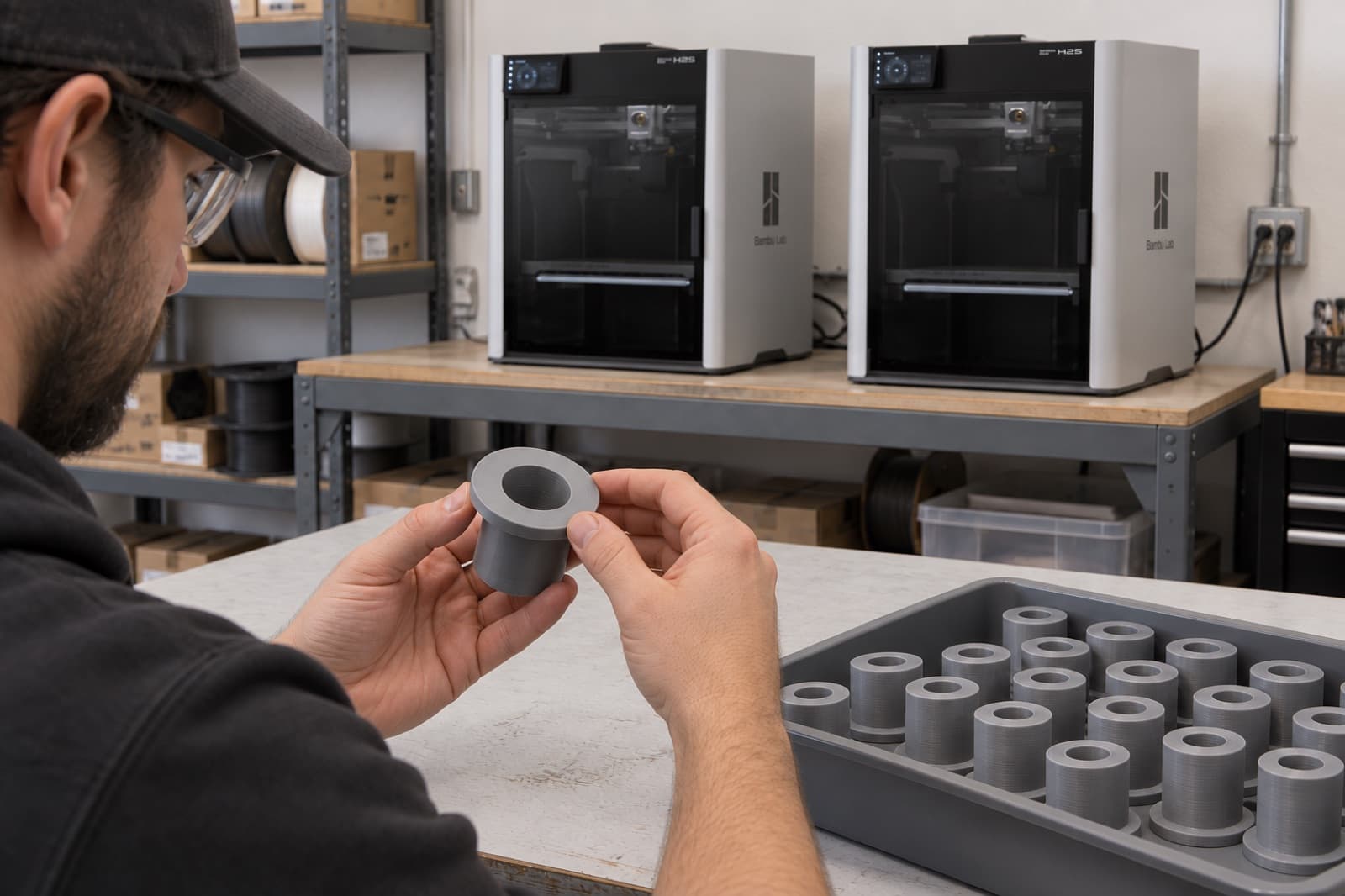
This is the bit we didn’t expect. The bezel never graduated to a mold and never got replaced. It became a normal part in Taylor’s system, and every year their trade compliance team gets in touch to certify where it’s made. That certificate is short and easy to sign: San Diego.
Why we like this one
A lot of printed parts are prototypes wearing a production badge — they exist until the real tooling arrives. This one was the opposite. It went in as a favour for a repair bench and quietly became infrastructure, because for a part consumed a handful at a time, tooling was never going to make sense.
It also only worked because Taylor was a genuinely good customer to iterate with. They told us exactly what was wrong, in pictures, fast — and they held the line on a finish standard we had to go earn. That is why the part is still in production.
If you’ve got a part like it — a small batch, on demand, no tooling — that is most of what we do.
This work was delivered under our former name, 037 Designs. Same shop, same owner, same machines — we now operate as TAKT 3D. The part is still in production.
Frequently asked questions
Can 3D printing match an injection-molded surface finish?
Close enough to pass inspection on a cosmetic part, yes — but it is print-setting work, not a material choice. Matching this molded bezel took four sample rounds of texture and resolution tuning. Plan on iteration if the finish is the acceptance criterion.
Why use ABS instead of PLA for a printed replacement part?
PLA deflects at about 52 °C, so any downstream heat step will deform it — on this job PLA parts failed a heat-and-flatten operation in the repair process. ABS holds up to heat and solvent smoothing, and it matched the original molded material.
When is printing better than cutting a new mold?
Whenever the part is needed in small batches, on demand, and the design might still move. A mold has to be paid for before the first good part exists. Printing has no tooling and no tooling lead time, so a part that is consumed a handful at a time never has to justify one.