Yes, we run a 3D printing shop in San Diego — and no, we’re not the right answer for every job. This is the guide we wish existed when customers call us asking about resin minis (we don’t print resin) or a $2 keychain (the library beats us on that). Four routes, honest trade-offs, real names.
- Need it fast and functional? A local service shop — rush turnaround, engineering materials, someone to call.
- Need an exotic process (SLS, MJF, metal)? A national manufacturing marketplace.
- Tiny budget, no deadline? The San Diego Central Library’s IDEA Lab.
- Printing weekly forever? Buy your own printer — seriously.
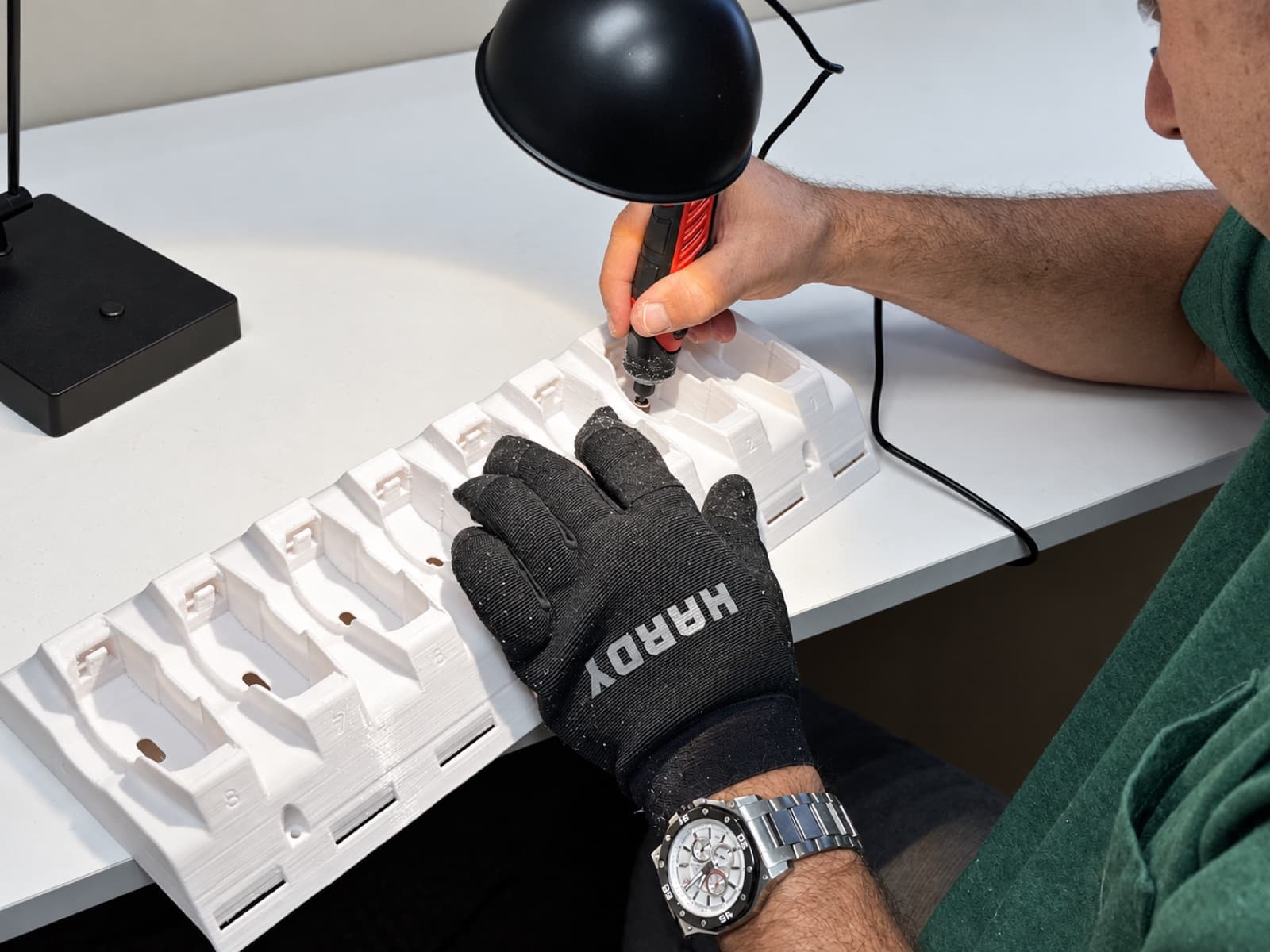
Option 1: Local San Diego service shops
The local-shop advantage is speed and conversation: same-day pickup, a human who looks at your file before it prints, and no freight in the loop. San Diego has a handful of real ones, most of them clustered in the Kearny Mesa–Miramar–Sorrento Valley triangle. Four things actually separate them, and they’re worth checking before you send anyone a file:
- Process. Most local shops are FDM. A few run SLA resin for jewelry-smooth finish and fine miniature detail — we’re FDM-only, so if that’s your part, go find a shop that runs resin. It’s a real reason not to use us.
- Materials ceiling. PLA and PETG are everywhere. Carbon-fiber nylon at 180°C HDT is not — ask before you assume. We print it in Miramar / Mira Mesa and keep the full material list published.
- How you get a price. Most shops, including good ones, still quote by email form. We publish per-cm³ rates and quote STL uploads in seconds.
- What “rush” means. Ask for the number, not the adjective. Ours is 1–2 business days on FDM, with free local pickup.
Option 2: National manufacturing marketplaces
Marketplaces route your file to a partner network — sometimes across the country, sometimes overseas. You trade away speed and direct contact, and you gain process breadth no local shop matches: SLS and MJF nylon, DMLS metal, CNC, injection molding, plus certifications (ITAR, AS9100) for regulated work.
- Choose a marketplace when you need a process beyond FDM/SLA, a cert a local shop can’t offer, or dozens of quotes compared automatically.
- Skip it when you need the part this week (shipping + partner queue routinely adds 5–10 days), or the job needs design conversation — marketplace DFM feedback is a checkbox, not an engineer.
Option 3: The San Diego Central Library IDEA Lab
The most underrated option in the county. The San Diego Public Library’s IDEA Lab (Central Library, downtown) offers 3D printing to library-card holders for roughly the cost of material, and staff will help you get a file printable. UCSD students and staff have an equivalent in the campus makerspace.
- Perfect for: one-off trinkets, student projects, first-time experiments, anything where “next month is fine.”
- Not for: engineering materials (expect PLA only), deadlines (queues run days to weeks), dimensional-critical parts, or anything commercial.
Genuinely: if your job fits the library, use the library. The people who come to us after outgrowing it — a part that must survive heat, a fit that must hold ±0.2 mm, a deadline measured in days — are our favorite customers anyway.
Option 4: Buy your own printer
A modern $300–$700 FDM printer (Bambu Lab A1/P1 class) is shockingly good, and if you print something every week, it pays for itself inside a year. We say this as a shop that theoretically loses business to it. Two honest caveats:
- Materials ceiling. Consumer machines handle PLA and PETG well. Carbon-fiber nylon like PA6-CF needs a hardened nozzle, a drying workflow, and a high-temp enclosure — that’s where a shop with production hardware stays useful even for printer owners.
- Your time is the real cost. Failed first layers, wet filament, and support surgery are part of ownership. Fine as a hobby; expensive as a production plan.
- Ventilation is a real consideration. NIOSH reports that fused filament fabrication desktop printers emit respiratory irritants, and that filament material and colour significantly affect VOC emission rates (NIOSH). A machine running for hours in an unventilated spare room is worth thinking about; a shop with enclosed machines and extraction is not the same environment.
Plenty of our customers own printers and send us the jobs their machine can’t take — bigger than the bed, hotter than the hotend, or due tomorrow morning.
The decision in one table
| Your situation | Best route |
|---|---|
| Functional part, needed this week | Local shop (instant quote) |
| SLA resin finish, local pickup | A local shop that runs resin |
| SLS / MJF / metal / certified work | A national marketplace |
| Cheap one-off, no deadline | Library IDEA Lab |
| A print a week, PLA/PETG, hobby time available | Buy a printer |
| Carbon fiber, heat, tolerance, or volume | Local shop with production hardware |
Neighborhood notes
Most of San Diego’s industrial 3D printing lives in the Kearny Mesa–Miramar–Sorrento Valley triangle, which is convenient if you’re a biotech in Sorrento Valley or a defense contractor off the 15 — and a haul from Chula Vista or downtown. Factor pickup drive time into the “local vs shipped” math; we keep per-neighborhood notes with drive times for exactly this reason.
Whichever route you pick: check the material actually matches the job (our material guide covers the four that handle 95% of work), and get the real price before you commit — from anyone. If a shop won’t show you a number without a form, ours are published.
Sources
Claims on this page that are not about our own shop, pricing, or turnaround are attributed inline. Full references:
- National Institute for Occupational Safety and Health (NIOSH), "3D Printing (Additive Manufacturing)", CDC (reviewed 16 July 2026). www.cdc.gov/niosh/manufacturing/additive/index.html (Government agency)